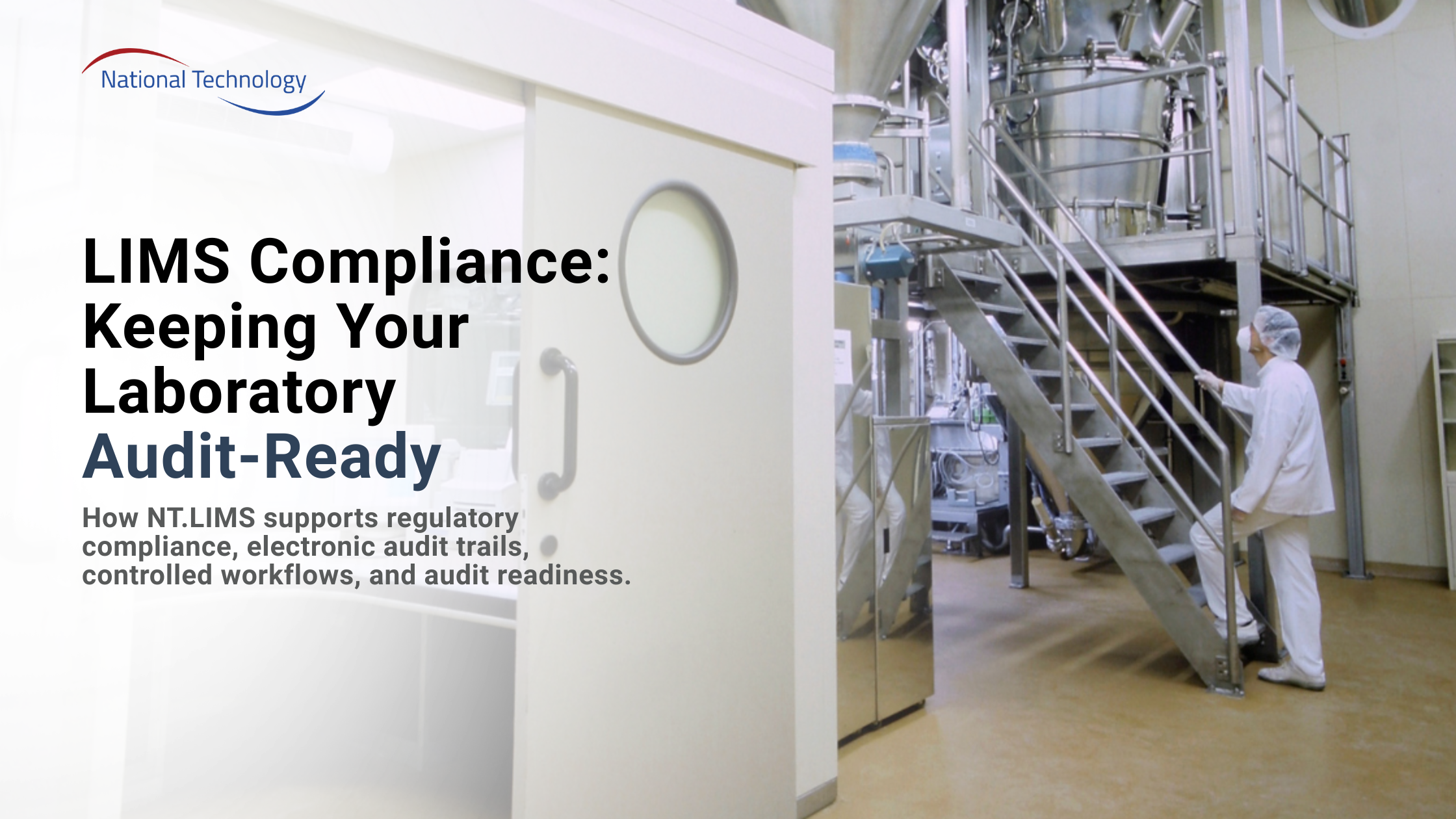
How National Technology LIMS Keeps Laboratories Audit-Ready: regulatory compliance, electronic audit trails, controlled workflows, and audit readiness.

LIMS compliance is the use of a Laboratory Information Management System to support regulatory requirements, controlled workflows, electronic records, audit trails, and data integrity within laboratory operations.
National Technology’s LIMS Supports Laboratory Compliance and helps laboratories maintain audit readiness by managing electronic signatures, controlled records, SOP versions, OOS/OOT workflows, and instrument calibration controls.
Why Laboratory Compliance Is Challenging
For laboratory managers and quality directors, regulatory compliance is not a checkbox — it is a daily liability. Whether you operate under ISO 17025, CAP, CLIA, FDA 21 CFR Part 11, or GMP frameworks, non-compliance carries severe consequences: failed audits, suspended accreditation, delayed product releases, and in regulated industries, significant legal exposure.
Yet in many labs today, compliance management still depends on spreadsheets, paper trails, disconnected systems, and manual staff reminders. The result is inevitable gaps — missing signatures, expired certificates, undocumented deviations, and incomplete audit trails that only surface when an inspector walks through the door.
Why Laboratory Regulatory Compliance Matters
The cost of non-compliance goes far beyond the audit itself:
- A single failed ISO 17025 audit can suspend accreditation and halt all testing operations
- Regulatory citations in pharmaceutical labs delay product approvals and cost millions in remediation
- Manual compliance tracking consumes an average of 15–20% of a quality team’s productive hours each week
- Without a complete electronic audit trail, demonstrating compliance to inspectors is slow, stressful, and unreliable
LIMS Supports Laboratory Compliance
National Technology LIMS transforms compliance from a reactive fire-fighting exercise into a proactive, automated discipline. The system is designed from the ground up to reflect the logic of regulatory frameworks — not just store data, but enforce process integrity at every step.
Key LIMS Compliance Features
- Electronic Audit Trail — Every action, modification, approval, and rejection is time-stamped, user-attributed, and immutable. Auditors can trace any result back to its origin in seconds.
- 21 CFR Part 11 & GMP-Ready Controls — Role-based access, electronic signatures, and controlled record management meet FDA and international GMP requirements out of the box.
- Certificate of Analysis (CoA) Management — Auto-generated CoAs with approval workflows, version control, and digital signatures ensure no non-conforming result is released.
- Method and SOP Version Control — NT.LIMS enforces the use of approved, current methods. Analysts cannot apply outdated procedures without an authorized override — and that override is logged.
- Out-of-Specification (OOS) & Out-of-Trend (OOT) Workflows — Automatic flagging, investigation assignment, and closure tracking ensure that deviations are never overlooked.
- Instrument Calibration Tracking — Calibration schedules, due-date alerts, and lockout of expired instruments prevent invalid data from entering results.
How National Technology Keeps LIMS Supports Laboratory Compliance
Business and Compliance Outcomes
Laboratories using NT.LIMS report transformational improvements in their compliance posture:
- Audit preparation time reduced from days to hours — with all documentation accessible in a structured, searchable system
- Zero instances of missing electronic signatures or unsigned approvals following system rollout
- Faster regulatory submissions due to complete, reliable data packages generated automatically
- Quality teams redirected from manual tracking to higher-value analytical and improvement work
| Key Insight | Compliance is not something you achieve once. It is something you maintain every day. NT.LIMS makes that maintenance automatic. |
FAQs
LIMS compliance refers to using a Laboratory Information Management System to support regulatory requirements, controlled processes, electronic records, audit trails, and data integrity.
A LIMS can support compliance by managing electronic audit trails, signatures, controlled records, SOP versions, deviations, and instrument calibration
NT.LIMS provides role-based access, electronic signatures, controlled record management, and electronic audit trails to support 21 CFR Part 11 requirements.
NT.LIMS keeps compliance-related records structured and searchable, including audit trails, approvals, signatures, SOP versions, deviations, and calibration records.
NT.LIMS automatically flags OOS and OOT results and supports investigation assignment and closure tracking.
An electronic audit trail records actions, modifications, approvals, and other relevant activities with timestamps and user attribution, supporting data integrity and audit readiness.
Conclusion
Your laboratory cannot afford to treat compliance as a periodic project. With National Technology LIMS Supports Laboratory Compliance. Audit-readiness is not a state you prepare for — it is the default state of your operation. From electronic signatures to complete audit trails and automated deviation management, NT.LIMS gives laboratory directors the confidence to open the door to any inspector, any day.
Unique Selling Points: LIMS Regulatory Compliance
| Always Audit Ready | Immutable audit trails, electronic signatures, and complete documentation ensure inspectors find nothing but order — every day, not just audit day. |
| Multi-Standard Coverage | A single platform supports ISO 17025, CLIA, CAP, FDA 21 CFR Part 11, GMP, and more — eliminating the cost of multiple compliance tools. |
| Automated OOS/OOT Management | Deviations are flagged, assigned, and tracked automatically, closing the gaps that manual systems inevitably miss. |
| Instrument Lockout Controls | Expired or unqualified instruments are blocked from use in active tests, preventing invalid data at the source. |
| Version-Controlled SOPs | Analysts always work with the current approved method. Unauthorized use of superseded procedures is structurally impossible. |